
If you are reading this, you may be carrying something heavy right now.
Perhaps you have lost someone you love. Perhaps a relationship has ended, and with it the future you had imagined. Perhaps your health has changed, or a job has gone, or your life simply looks nothing like you expected it would at this point. Perhaps you are supporting someone else through their grief, and finding that harder than you anticipated.
Whatever has brought you here, I want to say something plainly at the outset: grief is not a problem to be solved. It is not a malfunction. It is not a sign that you are weak, or stuck, or doing something wrong.
Grief is the price of love and attachment. It is one of the most profoundly human experiences there is — and it deserves to be met with honesty, not platitudes.
What Grief Actually Looks Like
One of the most isolating things about grief is how different it can look from what we expected — or from what others seem to think it should look like.
You might cry constantly. Or you might not cry at all, and worry that something is wrong with you. You might feel numb, or angry, or relieved, or guilty about feeling relieved. You might find that grief comes in waves — receding for a while, then returning suddenly and without warning, triggered by a song, a smell, an ordinary Tuesday afternoon.
You might feel fine at work and fall apart at home. Or the reverse. You might find yourself exhausted by well-meaning people telling you that time heals all wounds, or that your loved one is in a better place, or that everything happens for a reason.
None of this means you are grieving wrong. There is no wrong way to grieve.
What there is, however, is a difference between grief that moves — that is painful but alive, that gradually allows you to carry your loss alongside a life that still holds meaning — and grief that becomes stuck. Grief that contracts rather than expands. That closes off rather than opens up.
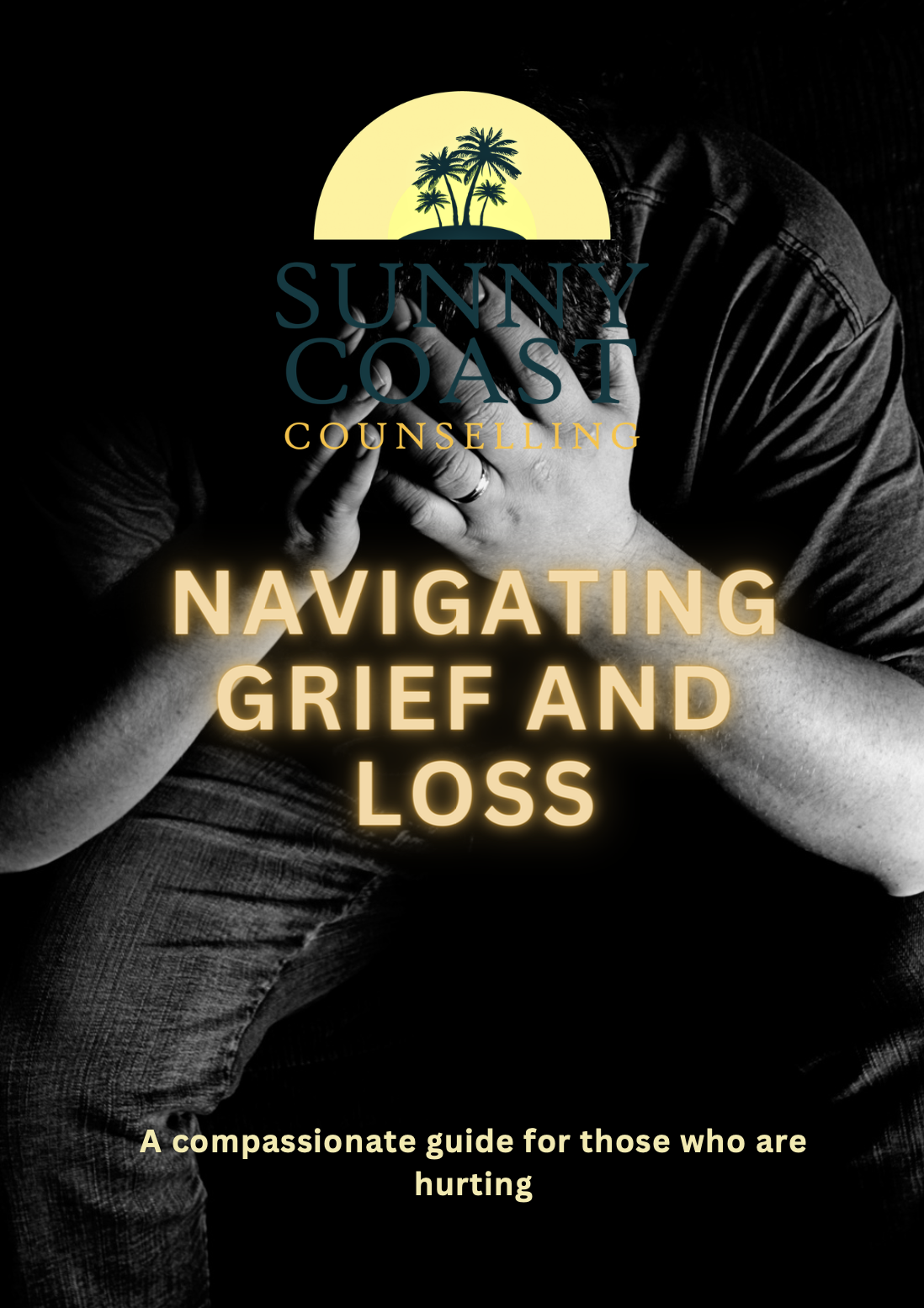
Understanding that difference, and knowing what supports the former, is at the heart of our new guide.
Introducing: Navigating Grief & Loss
This eBook has been written with warmth and honesty. It will not offer empty reassurances or tell you that everything happens for a reason. What it will do is help you understand what you are going through, offer some tools that may bring a measure of relief, and remind you that support is available whenever you are ready for it.
Here is a glimpse of what the guide covers:
🌊 Understanding What Grief Is — and What It Isn’t
The guide begins by gently unpacking what grief actually involves — including the many forms it can take beyond the loss of a person. Grief can follow the end of a relationship, a significant health change, the loss of a role or identity, a miscarriage, the loss of a pet, or a future that will no longer unfold the way you hoped. All of these losses are real, and all deserve acknowledgment.
📖 Moving Beyond the “Stages” Model
Many of us grew up with the idea that grief moves through five neat stages — denial, anger, bargaining, depression, acceptance — in a predictable order. Contemporary grief research tells a more nuanced story. The guide explores what we now understand about how grief actually unfolds, and why knowing this can be genuinely freeing.
🌿 An ACT-Informed Approach to Living With Loss
Woven throughout the guide are ideas drawn from Acceptance and Commitment Therapy (ACT) — one of the most well-researched approaches in contemporary psychology. ACT doesn’t ask you to get over your grief, or to think your way out of it, or to replace painful thoughts with positive ones. It asks something far more honest: can you make room for this pain, while still moving toward a life that matters?
This approach doesn’t minimise loss. It honours it — while gently opening a path forward.
🛠️ Practical Tools to Help You Through
The guide includes a range of practical, evidence-informed tools for navigating the harder moments — strategies for managing the physical weight of grief, for sitting with difficult emotions without being overwhelmed by them, and for gradually re-engaging with life without feeling like you are betraying what or who you have lost.
💛 Support for Those Who Are Supporting Someone Else
Grief doesn’t only affect the person at its centre. If you love someone who is grieving, you may find yourself uncertain — afraid of saying the wrong thing, unsure whether to bring it up or stay quiet, exhausted by your own helplessness. The guide offers thoughtful, practical guidance for those in this position too.
A Different Kind of Resource
This guide is deliberately not a clinical textbook. It has been written to feel like a conversation — the kind you might have with a counsellor who isn’t going to rush you, or tell you how you should be feeling, or offer a neat timeline for when things will get better.
You don’t need to read it all at once. In fact, the guide actively encourages you not to. Take it at your own pace. Return to the sections that feel helpful. Set it aside when you need to, and come back when you’re ready.
Grief has its own timeline. This guide will be there whenever you need it.
A Note From Me
Grief is one of the most sacred spaces I enter in my work as a counsellor. People bring their losses to the counselling room with tremendous courage — often for the first time, often after months or years of trying to carry everything alone.
What I have observed, consistently, is that grief eases not when it is fought or suppressed, but when it is understood and given room. When the person grieving feels less alone in what they are experiencing. When they begin to see that loving something and losing it does not have to be the end of their story.
That is what I hope this guide offers — a companion for a difficult journey, written with genuine care.
If you would like to explore your grief with some personal support alongside the guide, please don’t hesitate to reach out. You can contact me at john@sunnycoastcounselling.com.au or book a session online — in person, via Zoom or Teams, or by telephone.
Get Your Copy
Navigating Grief & Loss is available now through the Sunny Coast Counselling online store for $7.70.
If you are in the middle of something hard, or walking alongside someone who is, this guide was written with you in mind.
John Belchamber is a qualified counsellor and the Managing Counsellor at Sunny Coast Counselling, based on the Sunshine Coast, Queensland. Sunny Coast Counselling offers individual counselling, couples counselling, Employee Assistance Program (EAP) services, and wellness seminars — available in-person, via Zoom/Teams, and by telephone.
If you are experiencing a mental health crisis or need immediate support, please contact Lifeline on 13 11 14, Beyond Blue on 1300 22 4636 or dial 000.